 Often overlooked in favor of Nilsson Schmilsson or the John Lennon produced Pussy Cats when it comes to Nilsson's seventies output, Knnillssonn's saving grace is that the LP was his personal favorite at the time of its recording. Plus the music itself is pretty damn impressive to boot. With his voice having finally recovered from the train wreck sessions with Lennon, Nilsson set out to write a complete album of original material, handle the production duties himself and make a proper comeback record before it was too late. The resulting LP was exactly what Nilsson had intended. A lusciously produced album that served as a testament to his continued prowess as one of the decade's finest songwriters and one of the greatest achievements of his career. However, as fate would have it, Elvis died shortly before its release, RCA shifted its marketing focus and both Nilsson and Knnillssonn were hung out to dry. It would be the last record he would release in the US until his death nearly two decades later.
Showing posts sorted by relevance for query nilsson. Sort by date Show all posts
Showing posts sorted by relevance for query nilsson. Sort by date Show all posts
Wednesday
Nilsson
Knnillssonn - 1977
 Often overlooked in favor of Nilsson Schmilsson or the John Lennon produced Pussy Cats when it comes to Nilsson's seventies output, Knnillssonn's saving grace is that the LP was his personal favorite at the time of its recording. Plus the music itself is pretty damn impressive to boot. With his voice having finally recovered from the train wreck sessions with Lennon, Nilsson set out to write a complete album of original material, handle the production duties himself and make a proper comeback record before it was too late. The resulting LP was exactly what Nilsson had intended. A lusciously produced album that served as a testament to his continued prowess as one of the decade's finest songwriters and one of the greatest achievements of his career. However, as fate would have it, Elvis died shortly before its release, RCA shifted its marketing focus and both Nilsson and Knnillssonn were hung out to dry. It would be the last record he would release in the US until his death nearly two decades later.
Often overlooked in favor of Nilsson Schmilsson or the John Lennon produced Pussy Cats when it comes to Nilsson's seventies output, Knnillssonn's saving grace is that the LP was his personal favorite at the time of its recording. Plus the music itself is pretty damn impressive to boot. With his voice having finally recovered from the train wreck sessions with Lennon, Nilsson set out to write a complete album of original material, handle the production duties himself and make a proper comeback record before it was too late. The resulting LP was exactly what Nilsson had intended. A lusciously produced album that served as a testament to his continued prowess as one of the decade's finest songwriters and one of the greatest achievements of his career. However, as fate would have it, Elvis died shortly before its release, RCA shifted its marketing focus and both Nilsson and Knnillssonn were hung out to dry. It would be the last record he would release in the US until his death nearly two decades later. 
Monday
Harry Nilsson
Nilsson Sings Newman - 1970
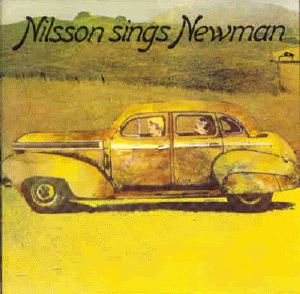
 While Nilsson began coming into his own at the beginning of the 1970s, Randy Newman was an unknown to anyone outside the world of music publishing and nonexistent as a performer. The critical appeal both would eventually (and rightfully) attain makes this artistic summit all the more poignant. Famously named "Record of the Year" by Stereo Review magazine, Nilsson Sings Newman stands well outside the mainstream of other LPs of this period - with Newman's piano providing the sole accompaniment to the multi-tracked army of Nilsson harmonies. Stunning from start to finish, but some of my favorites include "Vine St", "Love Story" and "Livin' Without You." Arguably the best album in Nilsson's catalogue and the ideal jumping off point for anyone with an interest in either artist.
Friday
Harry Nilsson
Pussy Cats - 1974
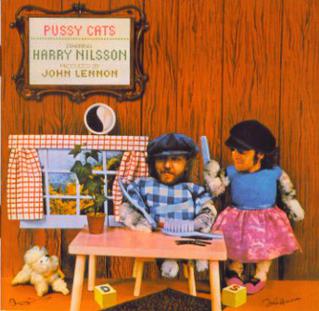 Listening to this album is the musical equivilent of watching a prize fighter in the decline of his career. Famously produced by John Lennon during his "Lost Weekend" period in 1974, Pussy Cats is often regarded as one of Nilsson's weaker albums due to the fact that he lost his voice halfway through the recording of it. Keeping the news from Lennon out of fear he'd abandon the project, Nilsson forged ahead, recording a slew of rock n' roll classics and engaging in drunken revelry with a huge cast of backing musicians that included Ringo, Keith Moon, Bobby Keys and Sneeky Pete Kleinow. While it's entertaining to hear Nilsson run through these oldies (each coated in a layer of Phil Spector glaze), the real treat here are his originals, which stack up as some of the most engaging in his entire catalogue--namely "Don't Forget Me" and "All My Life". My favorite of the bunch is "Old Forgotten Soldier", where his ragged voice fits the song's context so well you'd think he's putting you on. The four bonus tracks on this one include a great solo version of "Save the Last Dance for Me", with Nilsson accompanying himself on Fender Rhodes.
Listening to this album is the musical equivilent of watching a prize fighter in the decline of his career. Famously produced by John Lennon during his "Lost Weekend" period in 1974, Pussy Cats is often regarded as one of Nilsson's weaker albums due to the fact that he lost his voice halfway through the recording of it. Keeping the news from Lennon out of fear he'd abandon the project, Nilsson forged ahead, recording a slew of rock n' roll classics and engaging in drunken revelry with a huge cast of backing musicians that included Ringo, Keith Moon, Bobby Keys and Sneeky Pete Kleinow. While it's entertaining to hear Nilsson run through these oldies (each coated in a layer of Phil Spector glaze), the real treat here are his originals, which stack up as some of the most engaging in his entire catalogue--namely "Don't Forget Me" and "All My Life". My favorite of the bunch is "Old Forgotten Soldier", where his ragged voice fits the song's context so well you'd think he's putting you on. The four bonus tracks on this one include a great solo version of "Save the Last Dance for Me", with Nilsson accompanying himself on Fender Rhodes.Wednesday
Nilsson
Aerial Pandemonium Ballet - 1971
 With his star on the rise and his breakthrough LP Nilsson Schmilsson just around the corner, Harry Nilsson took it upon himself to introduce his newly acquired fan base to his earlier material, albeit in a wildly unconventional, but unmistakably Nilsson fashion. Rather than simply re-release his first two records, 1967's Pandemonium Shadow Show and '68's Aerial Ballet, Nilsson chopped, screwed, re-edited and in turn, created the world's first remix album from their contents. Those who hadn't heard the first two records wouldn't necessarily discover anything out of the ordinary, since both were stylistically very similar. But for the few who already had these two records in their collection, purchasing Aerial Pandemonium Ballet was still a no-brainer - even if there were no new songs on the album! Entire sections were slowed down, others were removed entirely, new vocals were added, songs were completely remixed and intros and outros were tacked on to create an entirely new beast, yet one that would remain faithful to the original. So far ahead of its time and an amazing record any way you look at it.
 With his star on the rise and his breakthrough LP Nilsson Schmilsson just around the corner, Harry Nilsson took it upon himself to introduce his newly acquired fan base to his earlier material, albeit in a wildly unconventional, but unmistakably Nilsson fashion. Rather than simply re-release his first two records, 1967's Pandemonium Shadow Show and '68's Aerial Ballet, Nilsson chopped, screwed, re-edited and in turn, created the world's first remix album from their contents. Those who hadn't heard the first two records wouldn't necessarily discover anything out of the ordinary, since both were stylistically very similar. But for the few who already had these two records in their collection, purchasing Aerial Pandemonium Ballet was still a no-brainer - even if there were no new songs on the album! Entire sections were slowed down, others were removed entirely, new vocals were added, songs were completely remixed and intros and outros were tacked on to create an entirely new beast, yet one that would remain faithful to the original. So far ahead of its time and an amazing record any way you look at it.
Nilsson
The Point! - 1971


While the same could be said for any of his albums, The Point is easily a high water mark in the career of Harry Nilsson. Thematically brilliant, densely orchestrated and packed with more hooks than a meat locker, The Point! was commissioned as the soundtrack to an ABC television special in 1971 with a voice-over narration by Dustin Hoffman. In subsequent VHS and DVD reissues of the film, Ringo has taken the voice over reins, while Nilsson handles narration duties on the album itself. But even without the narrative, the album would hold up as a tremendous concept in the sharply focused lyrical and musical themes that pop up across the entire LP. Brief bits of one song will be reprised in another, the story's characters are referenced throughout and all of the songs share similar instrumentation, however every tune is a magnificently crafted pop gem in and of itself. Here, at the peak of his power as songwriter, lyricist and singer, not a soul in the world could match Nilsson's ability. The entire album is required listening, but "Me and My Arrow" is one of my all-time favorites and "Thing About Your Troubles" is absolute perfection.
Thursday
For the Love of Harry!
 I proudly announce that the Heat Warps is donating all of its Harry Nilsson content to the fabulous new Nilsson-dedicated site, For the Love of Harry! Spearheaded by Willard, chief contributor over at Never Get Out of the Boat, For the Love of Harry will be all things Nilsson, all the time. So hesitate no longer, you're just a mouse click away from total Nilsson bliss!
Wednesday
Ron Wood
I've Got My Own Album To Do - 1974
 Ranking right up there with Harry Nilsson's Pussy Cats LP in terms of the greatest "buddy" album of all time, Ron Wood's first solo effort was one that simultaneously showcased his immense talent as a guitarist and songwriter, as well as his seemingly endless pool of kick ass rock star friends that were willing to lend him a hand. Considering his reputation as one of the all around nicest guys in rock music, it's no surprise that the list of guest musicians here includes not only the majority of the Rolling Stones, half of the the Faces and George Harrison but a wealth of contributors that remain uncredited (although I swear I hear the voice and drums of The Band's Levon Helm on a couple of tracks). Such an immense pool of musicians and the egos that they carry could have easily overwhelmed the proceedings here, but the sense of camaraderie and unabashed joy rules over this album, and the result is a tight collection of tunes that sounds exactly as you'd expect it to when considering the participants. Equal parts Stones and Faces, the LP features duets galore, most notably Jagger and Wood on the opening track, Keith Richards is all over the place here, obviously enjoying the brief step away from the spotlight, and the Faces' Ian McLagan is an absolute monster on the Wurlitzer piano. Hell, even Rod Stewart took a break from chasing supermodels to join in on the action. Easily one of the finest off-the-radar albums of the decade.
John Lennon, Part 2 of 3
The Complete Lost Lennon Tapes, Volume 2 (discs 9-15)
 The second volume of the Complete Lost Lennon Tapes picks up right where the first left off - which is easy enough since there's little rhyme or reason to the tracklisting. Nope, no tidy chronological order here, just seven more discs of outtakes, demos, alternate versions and comedy routines in startlingly high fidelity. Just like the first eight discs, the highlights here are innumerable, but I certainly have my favorites; the surprisingly fully formed acoustic demo of Abbey Road's "Because" and the work in progress takes of "Give Peace a Chance" on disc 14, a drum machine and acoustic guitar take on Jimmy Cliff's "Many Rivers to Cross" that rivals the version on Nilsson's Pussy Cats LP in terms of sheer beauty, and finally, the raw urgency lurking throughout the demo and studio versions of "Well Well Well" that bring disc 12 to a roaring boil. Head to the comments section for the seven discs (as well as the HTML and Autorun files) which comprise the second CD-ROM. The thrilling conclusion to this three-part series is just around the corner, so dew drop in next week.
 The second volume of the Complete Lost Lennon Tapes picks up right where the first left off - which is easy enough since there's little rhyme or reason to the tracklisting. Nope, no tidy chronological order here, just seven more discs of outtakes, demos, alternate versions and comedy routines in startlingly high fidelity. Just like the first eight discs, the highlights here are innumerable, but I certainly have my favorites; the surprisingly fully formed acoustic demo of Abbey Road's "Because" and the work in progress takes of "Give Peace a Chance" on disc 14, a drum machine and acoustic guitar take on Jimmy Cliff's "Many Rivers to Cross" that rivals the version on Nilsson's Pussy Cats LP in terms of sheer beauty, and finally, the raw urgency lurking throughout the demo and studio versions of "Well Well Well" that bring disc 12 to a roaring boil. Head to the comments section for the seven discs (as well as the HTML and Autorun files) which comprise the second CD-ROM. The thrilling conclusion to this three-part series is just around the corner, so dew drop in next week.
Monday
The Monkees
Head - 1968
 Quietly screaming "Hey Hey, We're Into Pot Too!", The Monkees' Head fell flat on its face when this giddy slice of stoned fun went completely over the top of the band's teenage audience. What a shame their marketing team didn't have the sense to see this coming a mile away. As a soundtrack to the equally confusing movie of the same name, Head is comprised of pointless snippets of hippy-drippy dialogue and some psychedelic gems that are well worth wading through the muck for. Highlights include the magnificent "Porpoise Song", the country-tinged "As We Go Along" and a take on Harry Nilsson's "Daddy's Song". Oddly short on actual songs, Head has, over time, helped to turn the notion of The Monkees as talentless clowns on its ... head. Enjoy.
 Quietly screaming "Hey Hey, We're Into Pot Too!", The Monkees' Head fell flat on its face when this giddy slice of stoned fun went completely over the top of the band's teenage audience. What a shame their marketing team didn't have the sense to see this coming a mile away. As a soundtrack to the equally confusing movie of the same name, Head is comprised of pointless snippets of hippy-drippy dialogue and some psychedelic gems that are well worth wading through the muck for. Highlights include the magnificent "Porpoise Song", the country-tinged "As We Go Along" and a take on Harry Nilsson's "Daddy's Song". Oddly short on actual songs, Head has, over time, helped to turn the notion of The Monkees as talentless clowns on its ... head. Enjoy.
John Lennon
Mind Games - 1973
 Mind Games marked the beginning of John Lennon's "lost weekend" period, and the evidence is all over this album. Having written the bulk of the material here immediately following his separation from Yoko, this is his first major step away from the political slant he had taken since the start of his solo career, and the album's tone is understandably mournful and apologietic throughout. That's not to say Mind Games is a downer. Much like Harry Nilsson's Pussycats LP he'd produce in 1974, Mind Games is a scattershot collection of tunes tend to come off as hastily written and recorded upon first listen, but reveal intense depth and an all encompassing tone of mayhem once they get under your skin. There are better John Lennon albums out there, but in case you've overlooked Mind Games, go ahead and give it a second chance. It's well worth it. The title track, "Aisumasen (I'm Sorry)" and "You Are Here" are a few of my favorites. Please enjoy.
 Mind Games marked the beginning of John Lennon's "lost weekend" period, and the evidence is all over this album. Having written the bulk of the material here immediately following his separation from Yoko, this is his first major step away from the political slant he had taken since the start of his solo career, and the album's tone is understandably mournful and apologietic throughout. That's not to say Mind Games is a downer. Much like Harry Nilsson's Pussycats LP he'd produce in 1974, Mind Games is a scattershot collection of tunes tend to come off as hastily written and recorded upon first listen, but reveal intense depth and an all encompassing tone of mayhem once they get under your skin. There are better John Lennon albums out there, but in case you've overlooked Mind Games, go ahead and give it a second chance. It's well worth it. The title track, "Aisumasen (I'm Sorry)" and "You Are Here" are a few of my favorites. Please enjoy.
Subscribe to:
Posts (Atom)